What does "multi-scale" actually mean?
Providing the correct data, the most robust physics, and the most intuitive tools to ensure the materials of tomorrow are discovered today.

Written by
Bianca Moretti
Insight
Jun 2, 2026
4 min read
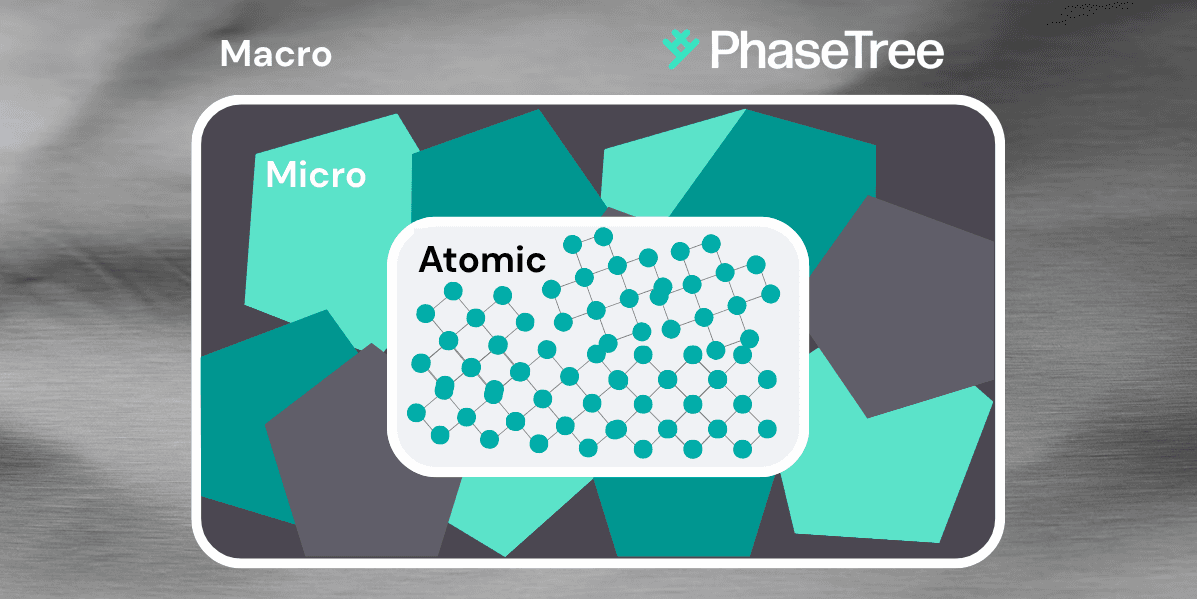
What does "multi-scale" actually mean?
You've seen the term in grant proposals, product decks, and conference abstracts. But what does it really mean to simulate a material "at multiple scales"? And why is it the central challenge - and central opportunity - in computational materials science today?
Multi-scale modelling means using different simulation methods at different levels of resolution - from quantum mechanics at the atomic level to continuum equations at the engineering scale - and connecting them so that information flows reliably between levels. In short: the right physics, at the right scale, linked together.
The problem: one scale is never enough
Matter organises itself across a vast range of length and time scales - from electrons interacting around individual atoms, all the way up to the cracks, phases, and deformations visible to the naked eye. The fundamental difficulty is that what happens at each scale is shaped by what's happening at the others.
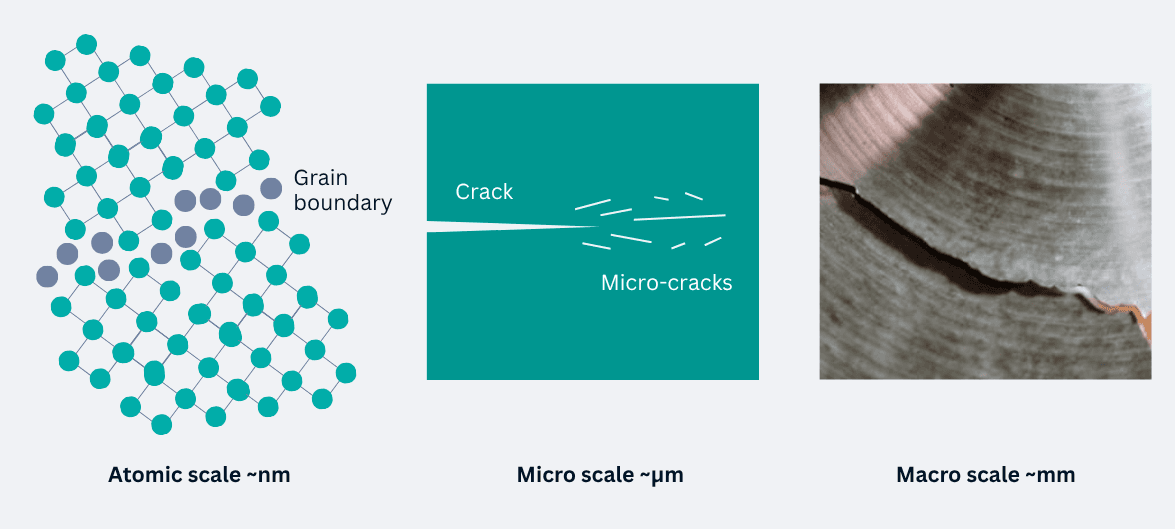
A metallic component doesn't fail because of a single misplaced atom. It fails because atomic-level chemistry at grain boundaries creates micro-scale defects, which grow under stress into macro-scale fractures. Understanding failure means understanding the full chain.
No single simulation method can span that full range efficiently: quantum mechanical calculations are extraordinarily accurate but limited to a few hundred atoms, and continuum methods can model an entire component but have no knowledge of atomic structure. Multi-scale modelling exists to bridge these worlds.
The scale ladder: four levels, four methods
Think of materials simulation as a ladder. Each rung operates at a different resolution, uses a different physical model, and answers different questions.
Each rung gives you capabilities unavailable at the rung below - but only by discarding fine-grained detail. The art of multi-scale modelling is in knowing exactly what to discard, and building principled bridges for passing what matters upward.
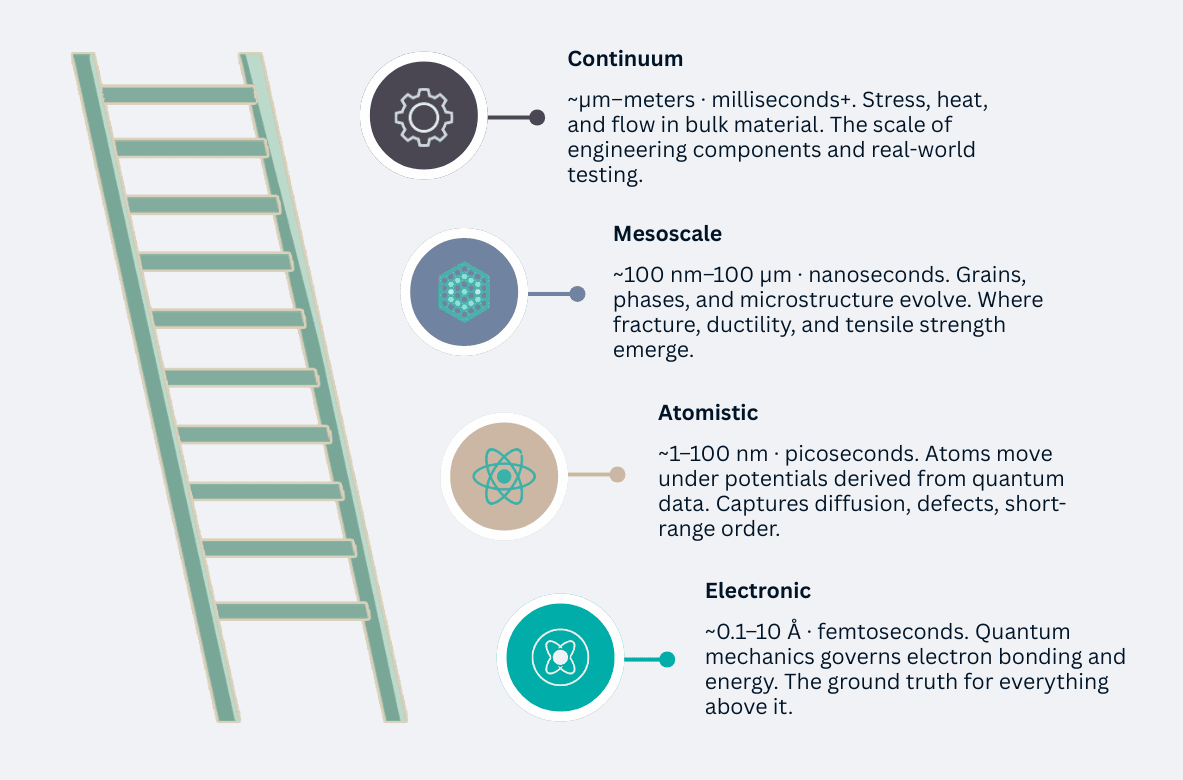
Different scales of material. At each scale correspond different approaches: at the electronic scale, Density Functional Theory (DFT) is used for modelling; at the atomistic scale, molecular dynamics and statistical methods are employed; mesoscale methods track how microstructure forms and changes over time; and finite element methods predict engineering-scale performance at the macroscopic level.
The hard part: bridging the scales
Describing four scales is straightforward. Connecting them faithfully is where the real scientific challenge lies. There are two dominant approaches:
Sequential (hierarchical): run a fine-scale simulation, extract key parameters - an energy landscape, a diffusion coefficient, an elastic modulus - and feed them as inputs to a coarser model. Computationally tractable, and effective when the scales are only weakly coupled to each other.
Concurrent: run fine and coarse simulations simultaneously on different regions of the same domain, with a handshake zone in between. Captures strong, real-time coupling between scales, but requires careful treatment of the interface to avoid artefacts.
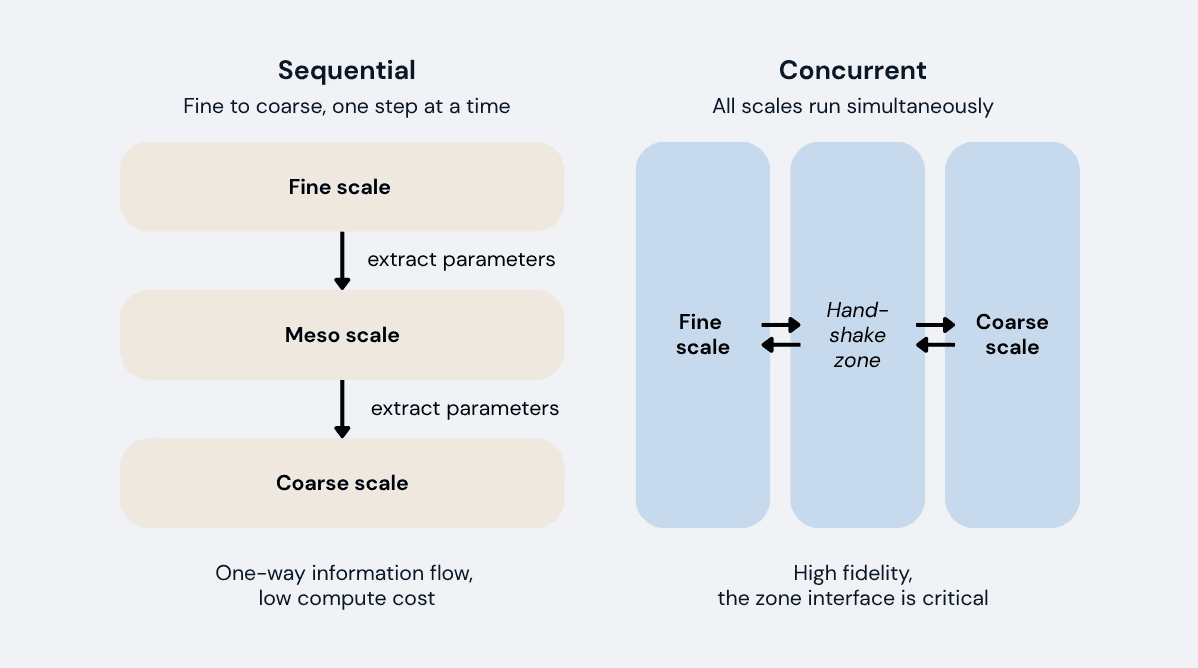
Two approaches to multi-scale simulation: sequential (left), and concurrent (right).
In both cases, the central question is not just accuracy within a single level, but how errors and assumptions propagate across the chain. A prediction is only as trustworthy as its weakest handoff.
Why it matters now: driving forces
AI is closing the quantum-to-atomistic gap
Machine-learned interatomic potentials - neural-network models trained on quantum mechanical data - can now simulate large atomic systems at a fraction of the cost of first-principles methods, while retaining much of their accuracy. The result is a broader discovery funnel: more candidate structures can be screened thermodynamically than ever before.
Mesoscale modelling is maturing
Mesoscale methods have advanced considerably, allowing simulation of phenomena like grain boundary formation, phase separation, and crack propagation at the microstructure level. Closing the gap between atomistic outputs and mesoscale inputs - reliably and automatically - remains one of the field's most active research frontiers.
The discovery pipeline is becoming deterministic
When each scale in the chain is connected by a validated, physics-grounded handoff, it becomes possible to design materials from first principles - starting from a target property and working backward through the simulation stack, rather than relying on experimental trial and error. This shift, from serendipitous discovery to deterministic design, is the defining challenge of the decade.


