Why can’t we just test every material?
Providing the correct data, the most robust physics, and the most intuitive tools to ensure the materials of tomorrow are discovered today.

Written by
Bianca Moretti
Insight
Oct 2, 2026
4 min read

A list of ingredients tells you surprisingly little about a recipe. In the same way, a list of elements tells you surprisingly little about a material. Two materials made from the same elements can be soft or hard, durable or brittle, long-lasting or short-lived. The proportions and the arrangement of the atoms make the difference. In this blog post, we look at this idea in three settings: alloys, phase diagrams and batteries. All three lead to the same conclusion:
Composition and structure, not just the ingredients, decide what a material can do. Small changes in either can produce a completely different material, and real materials have far more possible combinations than anyone could test one at a time.
Alloys: small additions, large changes
An alloy is a metal mixed with one or more other elements, in specific proportions, to change its properties.
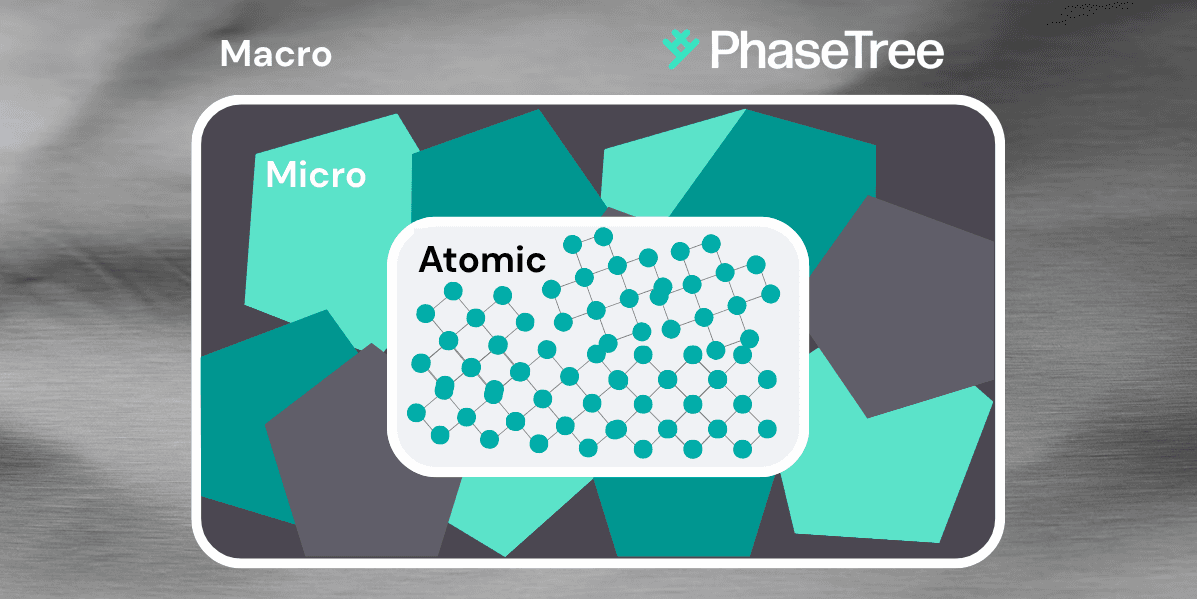
Pure iron is soft and corrodes easily. An old iron nail is a good example: you can bend it by hand and it rusts quickly. Add up to roughly 2% carbon by weight and you get steel, the material used in bridge cables. In steel, carbon atoms sit in the gaps of iron’s crystal lattice. There they block dislocation motion, the microscopic slip that lets a metal deform under stress. The result is a metal that takes much more stress before it bends or breaks.

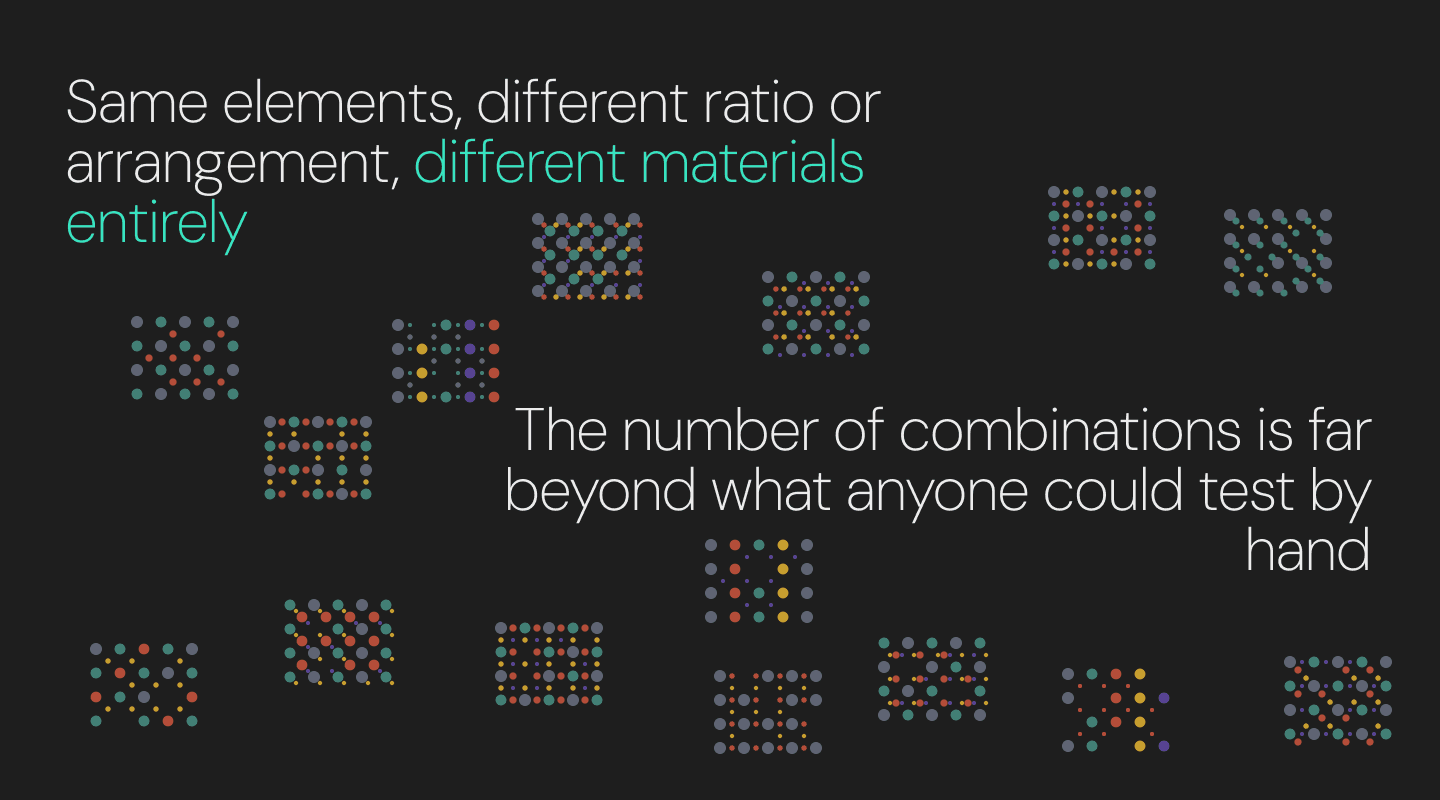
A very small addition produces a very large change in properties. This is also why alloys don’t behave the way you might expect. Use the same elements at a different ratio, or arrange them differently in the lattice, and you can get a completely different material.
That example covered only one addition, carbon. Real alloys can mix five, six or more elements, each at a different ratio and arranged in different ways through the lattice.

Phase diagrams: a map of material structures
If composition and structure decide properties, the next question is which structure a material ends up in. A phase diagram answers that. It is a map showing which physical structure a material settles into, depending on its temperature and its composition.
Most people already understand part of this from water. Below 0°C it’s ice and above 0°C it’s liquid. That map has one axis, temperature, and one ingredient.
Add salt and the map gets a second axis. The freezing point drops, and how far it drops depends on how much salt is dissolved. Plot temperature against salt content and you have a real phase diagram: two ingredients, two axes.

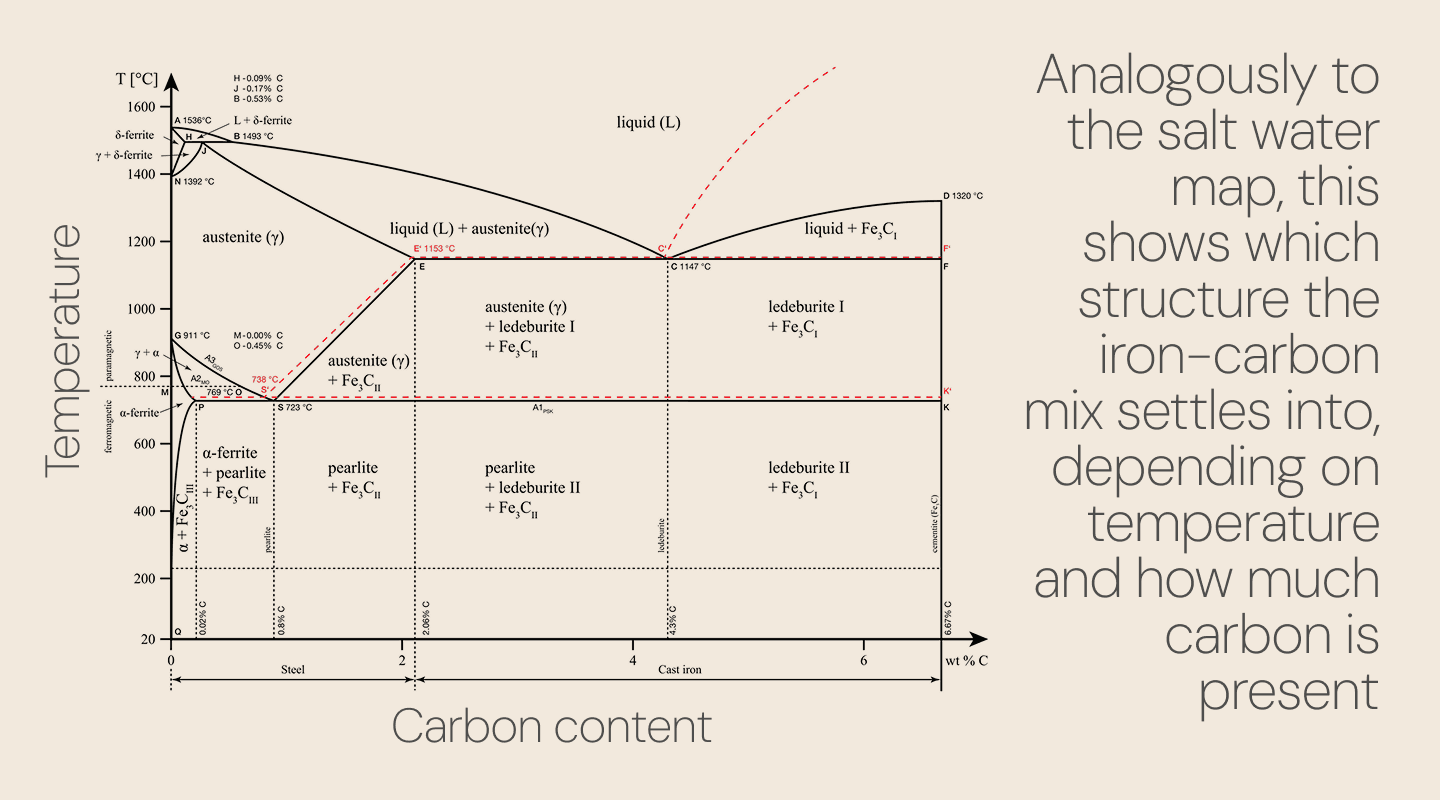
Alloys work the same way. Depending on temperature and carbon content, an iron-carbon mix settles into different structures. Each has its own name and its own properties. At one point on the map the metal is soft and workable. At another it is hard and brittle.
This is the basis of heat treatment. Heat steel enough and it turns into austenite, a structure with room for carbon atoms between the iron atoms. Cool it slowly and the structure has time to settle into its stable, softer form. Cool it very fast (quench it) and the structure gets frozen partway through the change. It locks into martensite, a harder and more brittle form that would never appear if the steel cooled slowly. Which form the steel ends up in depends on something as simple as cooling speed.
The iron-carbon diagram has only two ingredients, and it still took decades of careful measurement to map. Alloys used in aerospace, batteries or turbines have five or six elements, sometimes more, and each one shifts where the boundaries sit.
Batteries: where the materials set the limits
Batteries show the same principle in a product almost everyone uses.
A battery has two electrodes, a positive one and a negative one. Between them sits an electrolyte, a material that lets charged particles called ions pass through but blocks electrons. When the battery is in use, ions move through the electrolyte from one electrode to the other. The electrons can’t pass through the electrolyte, so they go the long way around, through the device being powered. That flow of electrons is the current.
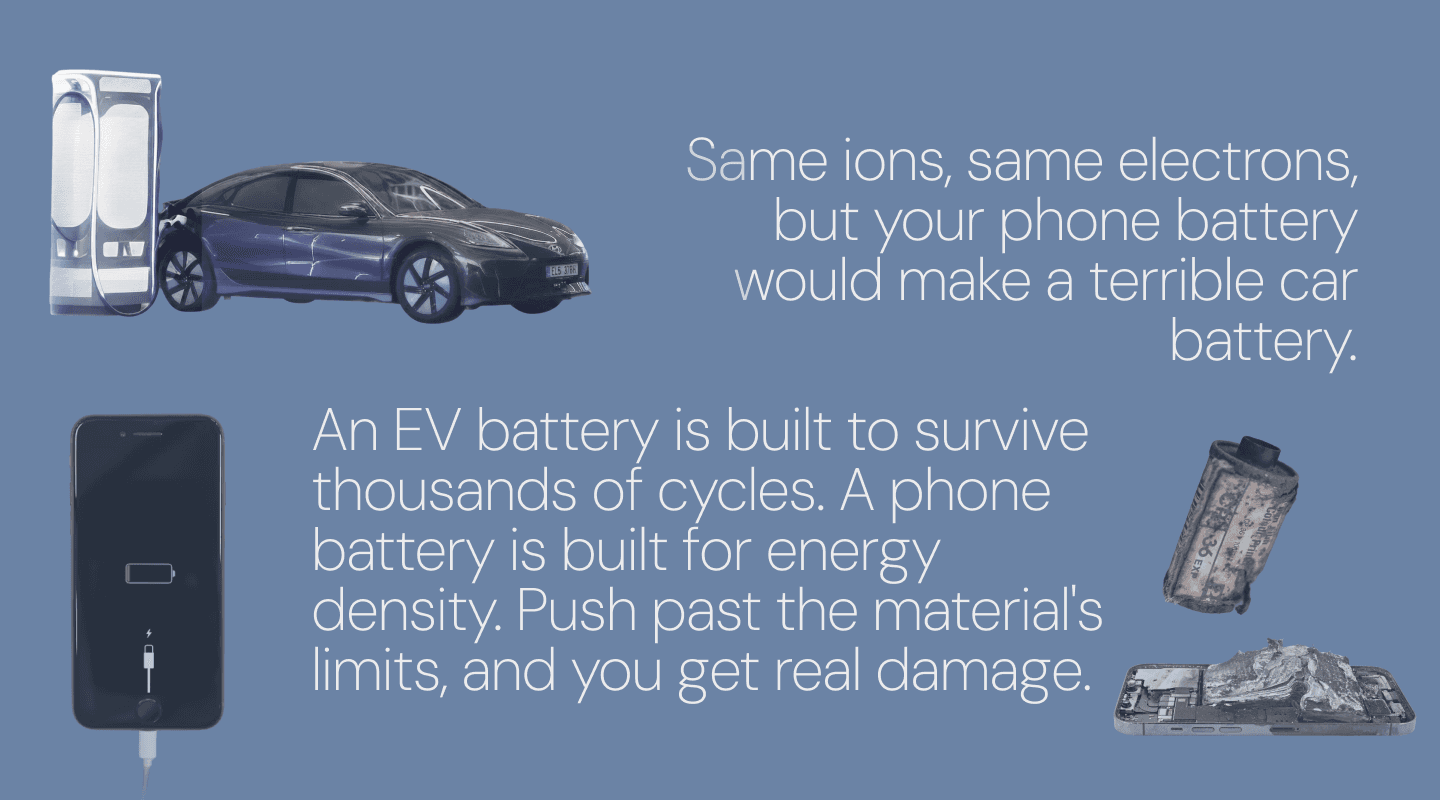
Compare a phone battery with an EV battery. Both work the same basic way, but they are built from different materials, chosen for different tradeoffs. A phone battery packs as much energy as possible into a small space. An EV battery is built to last thousands of charge cycles without degrading, because nobody wants to replace a car battery every two years.
Both limits come back to the same two questions. How much lithium can the electrode’s structure hold? And how well does that structure survive ions moving in and out of it, over and over, without cracking or wearing down?
Push a battery past what its materials were designed for, by charging it too fast or running it outside its temperature window, and you get lithium plating or structural damage. Better power electronics can’t fix that. The ceiling is set by the materials.
Electrode materials aren’t chosen from a short list either. There is a wide space of possible compositions and structures, each trading off energy density, charge speed, lifespan and supply chain availability differently.
The common thread: a search space too large to test by hand
Put the three together and the pattern is clear:
Alloys show that composition and structure decide properties.
Phase diagrams show that the structure itself depends on composition and processing, and that mapping even two ingredients takes decades.
Batteries show that performance limits are set by materials, chosen from a space of options far larger than any lab can screen.
Mapping that space experimentally, one composition and one cooling rate at a time, isn’t practical. That isn’t because labs are slow. The number of combinations grows much faster than the number of experiments anyone can run.
This is where computational approaches come in. Physics-based simulation can predict which structures a composition will form, how stable they are and how they will behave, before anyone makes a sample. AI can then search that physically grounded space much faster than trial and error. The goal isn’t to replace experiments. It is to make sure the experiments that do get run are the ones most worth running.
Physics first, AI on top: that’s how we approach the problem at PhaseTree.